MVP Stage

OperaIQ

Enterprise Data Graph for Cross-System Operational Intelligence

Your ERP, CRM, and data warehouses contain the answers your teams need. The problem is that no one can see across all of them at once — and by the time analysts stitch the picture together, the moment has passed. OperaIQ maps your enterprise data into a live object graph, layers AI reasoning on top, and gives every decision-maker a unified view of operations — queryable in plain language, actionable in real time.

Request Early Access
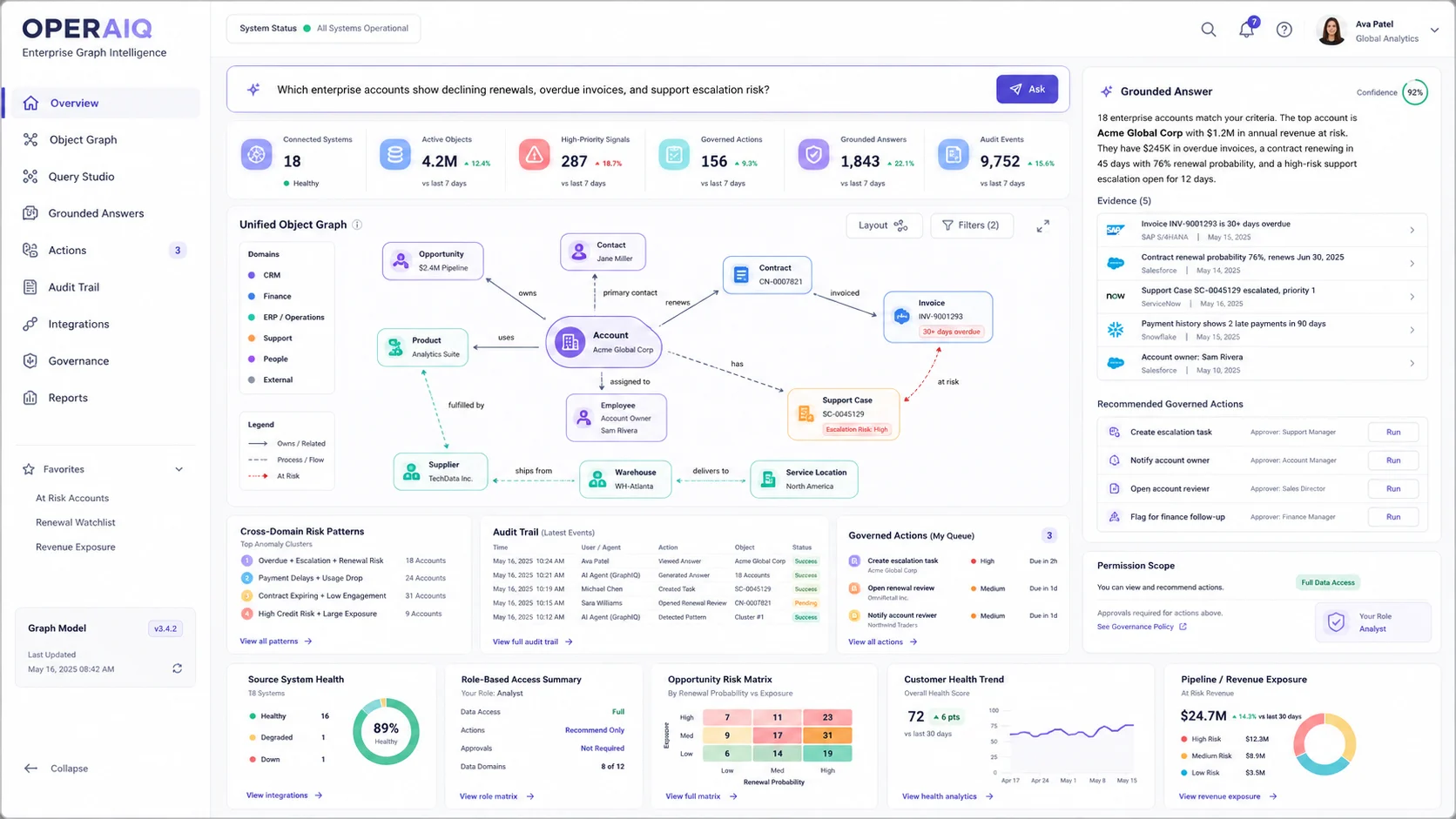
Sample Dashboard

Dashboards are tailored to each client's operational domain, data sources, and team workflows.

OperaIQ dashboard showing enterprise graph intelligence and data connectivity interface

What OperaIQ Does

Unified Object Graph

Connect your existing data sources — ERP, CRM, data warehouses, SharePoint, internal databases — into a single semantic model. Every customer, transaction, supplier, and event becomes a linked object with verifiable relationships.

AI-Powered Pattern Detection

Surface connections and anomalies that no dashboard or BI tool would find. OperaIQ's AI traverses the object graph to detect structural patterns, temporal drift, and cross-domain signals — and delivers them in plain language.

Natural Language Operations

Ask your data a question the way you would ask a colleague. OperaIQ reasons over the live graph to return grounded, traceable answers — not summaries of documents, but conclusions anchored to verified enterprise facts.

Automate With Custom Agents

Custom Agent Workflows

Define task-specific AI agents that operate directly on the OperaIQ object graph. Each agent is scoped to a set of object types, authorized actions, and permission boundaries — so automation runs within the same governance model as human users, not around it.

Financial Compliance Agents

Deploy agents that continuously monitor client, transaction, and counterparty objects for compliance signals — FINTRAC reporting thresholds, KYC review windows, unusual transaction patterns — and trigger escalation workflows automatically when conditions are met.

Client Risk Monitoring Agents

Configure agents that watch relationship clusters across your CRM and credit data — surfacing concentration risk, renewal pressure, or churn signals before account managers see them. Agents run on a defined schedule or in response to graph events, not on demand.

Procurement and Vendor Intelligence Agents

Agents that traverse supplier and contract objects to detect vendor concentration risk, flag contracts approaching expiry without renewal activity, or correlate delivery failures with specific supplier relationships — generating structured briefings for procurement teams on a defined cadence.

Escalation and Handoff Agents

Define multi-step agents that detect a trigger condition in the graph, assemble the relevant context from connected objects, draft a structured summary, and route it to the right team — via CRM task creation, email, or internal ticketing — without human intervention at each step.

Agent Audit and Explainability

Every agent action is logged against the object it acted on, the reasoning trace that produced it, and the authorization context under which it ran. Agents are not black boxes. Every automated decision is traceable back to the data that caused it.

Why Enterprise AI Fails Without Structure

Most organizations have invested heavily in data infrastructure — cloud warehouses, BI platforms, dashboards. Yet critical decisions still take days, because the data that matters is split across a dozen systems that do not talk to each other.

A customer's credit risk lives in one system. Their open disputes live in another. Their renewal timeline is in a third. No single analyst can hold all of that simultaneously — and no standard BI tool connects it automatically.

Large language models make this worse, not better, when deployed naively. An LLM handed a pile of documents can generate text, but it cannot tell you that the supplier flagged in one system is the same entity as the vendor with three open complaints in another. It does not understand your world. It guesses.

OperaIQ solves this at the foundation. Before any AI reasoning begins, your enterprise data is mapped into a Context Fabric — a connected model of every entity, relationship, and event that matters to your operations. The AI then reasons on top of this model, not on raw text. The result is answers that are specific, traceable, and grounded in the actual state of your business.

Built for Canadian Enterprise

OperaIQ is designed for mid-market and enterprise organizations operating in environments where data sovereignty, regulatory compliance, and operational complexity are non-negotiable.

Financial Services and Insurance

Canadian financial institutions carry enormous operational complexity across claims, compliance, client relationships, and risk exposure. OperaIQ connects these domains into a single picture — surfacing patterns that signal fraud, compliance drift, or churn risk before they become incidents. Deployed on Canadian cloud infrastructure, fully compliant with PIPEDA and provincial privacy requirements.

Supply Chain and Logistics

Fragmented supplier data, shipment records, and contract timelines create blind spots that cost organizations millions. OperaIQ maps supplier relationships, flags concentration risk, and surfaces delivery anomalies across the full supply network — giving procurement and operations teams the visibility they have never had.

Professional Services and Legal

Complex client matters, regulatory filings, and multi-party relationships generate data that is notoriously hard to track across systems. OperaIQ connects engagement data, deadlines, and entity relationships into a queryable graph — so partners and analysts spend less time assembling the picture and more time acting on it.


Engineering Details

OperaIQ is built on a modular architecture that separates data ingestion, cognitive graph construction, and AI reasoning into independent layers. Data connectors ingest from relational databases, CRM APIs, document stores, and cloud data warehouses. Every ingested record is mapped into the semantic model with full provenance metadata — origin, processing history, and confidence score are tracked at the field level.

The cognitive graph layer resolves entities across sources, deduplicates records, and establishes typed relationships between objects. The graph is live — as new data arrives, objects and links update without manual intervention. Schema changes are versioned and auditable.

The AI reasoning layer operates entirely on the cognitive graph. Natural language queries are translated into graph traversals and structured lookups — not document retrievals. All models run locally or within the client's private cloud environment. No data is sent to third-party AI services. Deployment options include Canadian cloud (Azure Canada Central, AWS ca-central-1) and on-premise for organizations with stricter data residency requirements.

Role-based access control is enforced at the object and property level — not at the query level. This means different users can ask the same question and receive answers scoped to their authorized view of the graph.

Request Early Access

OperaIQ is currently in MVP development. We are working with a small number of design partners who will shape the product roadmap and receive priority deployment support. If your organization is dealing with fragmented data, slow decision cycles, or AI deployments that have not reached production — bring us your problem.

Get in Touch