MVP Stage

Meridian

Operational Knowledge Graph for Resource and Energy Companies

Energy, mining, and utilities operators manage enormous complexity across assets, maintenance cycles, regulatory inspections, and field operations — spread across GIS systems, SCADA feeds, ERP databases, and stacks of PDF inspection reports. No single operator can hold all of it at once. Meridian maps your entire operational domain into a live knowledge graph, surfaces compliance risk and asset anomalies automatically, and gives your teams a single place to query, monitor, and act — in plain language, in real time.

Request Early Access
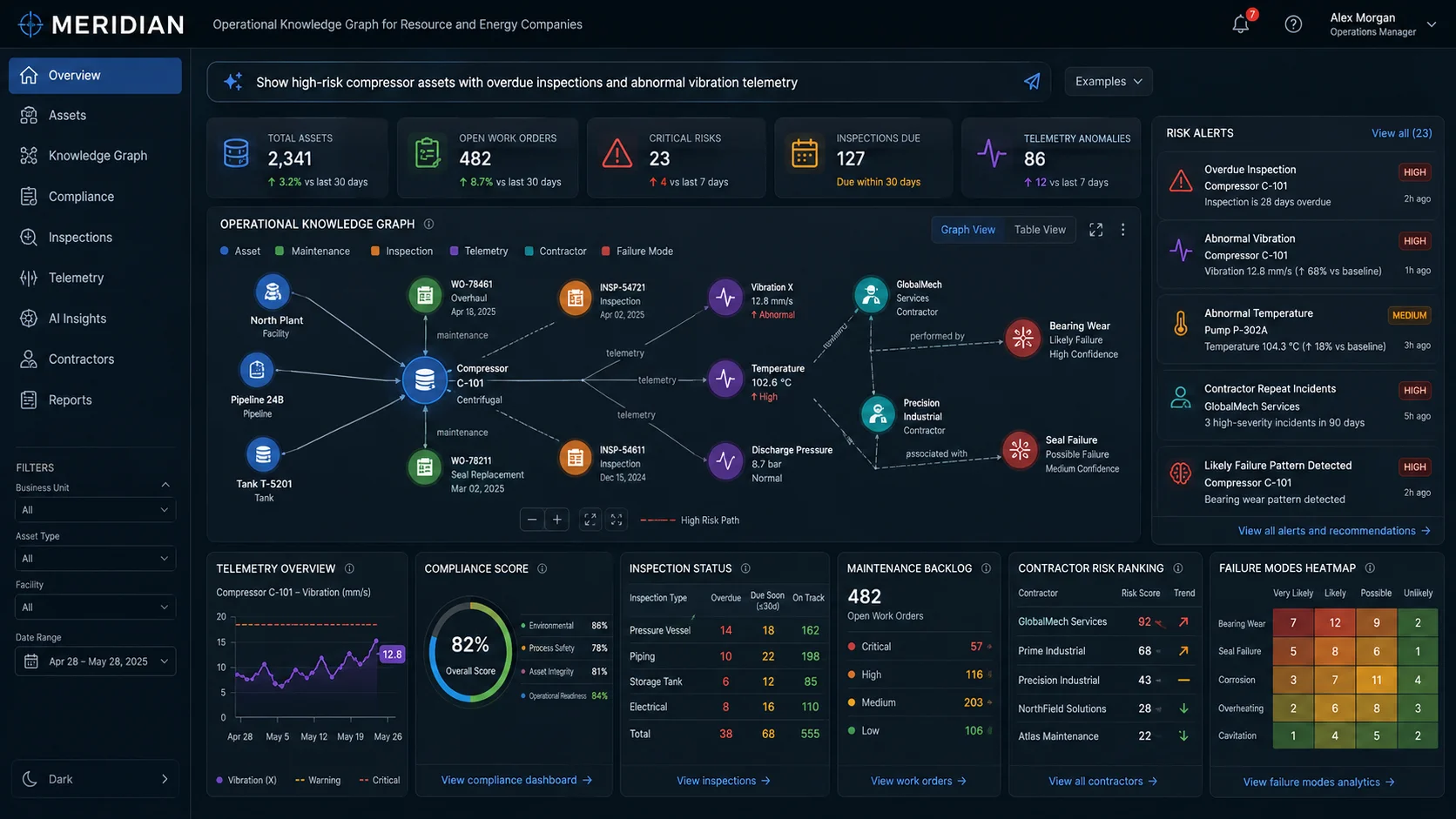
Sample Dashboard

Dashboards are tailored to each client's operational domain, data sources, and team workflows.

Meridian operational dashboard showing asset knowledge graph, compliance tracking, and anomaly detection interface

What Meridian Does

Asset Knowledge Graph

Every asset — pipeline segment, well, turbine, substation, mine shaft — becomes a linked object in a live graph. Maintenance records, inspection history, crew assignments, regulatory deadlines, and sensor telemetry are all connected to the asset they belong to. Nothing lives in a silo.

Anomaly and Pattern Detection

Meridian's AI traverses the asset graph to detect patterns that spreadsheets and dashboards miss: maintenance contractors correlated with premature asset failures, inspection scores declining across an asset class, sensor drift that precedes critical failures. These signals surface automatically — not after an incident, before one.

Natural Language Field Queries

Operators and engineers ask questions the way they think. Meridian translates plain language into graph queries across the full operational domain — assets, maintenance logs, inspection records, regulatory filings, and geospatial data — and returns grounded answers anchored to live operational data.

Work Order and Action Layer

Close the gap between insight and execution. Meridian can generate inspection work orders, flag assets for review, and notify field supervisors — with every action governed by organizational permissions and logged in a complete audit trail.

Automate With Custom Agents

Custom Agent Workflows

Define operational agents that run continuously against the Meridian asset graph — monitoring asset states, compliance windows, and sensor streams — and execute field actions when conditions are met. Agents inherit the same role-based permissions and audit controls as human operators.

Inspection and Compliance Agents

Deploy agents that track regulatory inspection windows across every asset in the graph — AER, CER, OEB, and provincial requirements — and automatically generate work orders, notify field supervisors, and escalate to compliance leads when deadlines approach or are missed.

Asset Health Monitoring Agents

Configure agents that watch sensor telemetry and maintenance history for early failure signals — pressure drift, vibration anomalies, repeated minor maintenance events on the same component — and surface risk flags before a failure occurs. Agents correlate across asset class, geography, and contractor to detect systemic patterns, not just individual incidents.

Contractor and Vendor Performance Agents

Agents that continuously correlate maintenance contractor records with asset failure events, inspection outcomes, and cost overruns — automatically flagging contractor relationships that show statistically anomalous performance across the asset graph.

Field Alert and Dispatch Agents

Configure agents that detect an asset condition, pull the relevant maintenance history and crew availability from the graph, and dispatch a structured alert to the appropriate field team — with full operational context attached, not just a raw alarm.

Agent Audit and Explainability

Every agent action — work order created, alert dispatched, report generated — is logged against the asset object it acted on, with the full reasoning trace and data lineage preserved. Regulators and operators can reconstruct exactly what the agent saw, what it decided, and why.

Operational Data in the Resource Sector Is a Disaster

A mid-tier Canadian energy operator might manage hundreds of assets across multiple basins. Their asset register lives in one system. Maintenance records are in another. Inspection reports are PDFs in a shared drive. Regulatory deadlines are tracked in spreadsheets. Sensor telemetry comes from SCADA systems that predate the cloud. And GIS data sits in its own isolated environment.

When an incident occurs, or when regulators ask questions, assembling a coherent picture of what happened, and why, takes weeks. When a compliance window is approaching, someone has to manually check each system and correlate records by hand. When a pattern of failures emerges — the same contractor, the same component, the same failure mode across 12 assets — no one sees it until the losses are already counted.

This is not a data shortage problem. Resource sector operators are drowning in data. It is a structure problem. The data exists, but it is not connected. It cannot be reasoned over. It cannot be queried. It cannot surface patterns on its own.

Meridian solves this at the foundation. Before any analysis begins, your operational data is mapped into a knowledge graph — a live, typed model of every asset, relationship, and event that matters to your operations. The graph is the ground truth. AI then reasons on top of it, not on raw documents, not on unstructured text. The result is operational intelligence that is specific, explainable, and connected to real evidence.

Built for the Canadian Resource Sector

Meridian is designed for energy operators, mining companies, and utilities who operate under complex regulatory frameworks, manage distributed physical assets, and cannot afford compliance failures or unplanned downtime.

Oil and Gas Operators

Canadian upstream and midstream operators face regulatory requirements from the AER, CER, and provincial bodies — across assets spread across vast and often remote geographies. Meridian connects asset data, inspection records, and regulatory timelines into a single queryable model. Compliance gaps surface automatically. Field teams get answers without calling the office.

Mining Companies

Mine operations generate data across geology, equipment, environmental monitoring, safety inspections, and production — rarely in the same system. Meridian maps the full operational picture into a knowledge graph, enabling safety and operations teams to detect equipment failure patterns, track regulatory compliance, and coordinate field actions from a unified platform.

Utilities and Transmission Operators

Power and pipeline operators manage infrastructure that must perform continuously under regulatory scrutiny. Meridian tracks asset health, maintenance history, and inspection compliance across the full network — surfacing degradation patterns and regulatory risk before they become outages or enforcement actions.


Engineering Details

Meridian is built on a modular architecture that separates data ingestion, graph construction, and AI reasoning into independent layers. Connectors ingest from geospatial data sources (shapefiles, GeoJSON, WMS feeds), time-series and SCADA systems (CSV ingest, InfluxDB, OSIsoft PI), relational asset registers and ERP systems, and unstructured document sources including PDF inspection reports and maintenance logs processed via document intelligence pipelines.

Every ingested record is mapped into the operational knowledge graph with full provenance metadata — origin, timestamp, processing history, and confidence score are tracked at the field level. Assets are modeled as first-class objects with typed relationships to maintenance records, inspection events, regulatory requirements, crew assignments, and sensor streams. The graph is live: as new data arrives — a completed inspection, a new sensor reading, a regulatory update — the graph updates without manual intervention.

The AI reasoning layer operates entirely on the graph. Natural language queries are translated into graph traversals and structured lookups. Pattern detection runs as continuous background processes, surfacing anomalies and compliance signals as they emerge. All models run locally or within the client's private cloud. No operational data is transmitted to third-party services.

Deployment options include on-premise for operators with air-gap requirements, Canadian cloud (Azure Canada Central, AWS ca-central-1) for organizations with cloud-first mandates, and hybrid configurations for operators who need both. The platform is designed for the regulatory and sovereignty requirements of Canadian resource sector operations from the ground up.

Request Early Access

Meridian is currently in MVP development. We are working with a small number of design partners in the Canadian energy and mining sector who will shape the product roadmap and receive priority deployment support. If your organization is managing asset complexity, compliance risk, or operational data silos that have resisted every previous solution — bring us the problem.

Get in Touch